Bal Gopal Lesson Plans
Bal Gopal - Lesson#1
Note
These lesson plans are part of the ISKCON Bhakta Prahlad Sunday School (BPSS) curriculum. They are designed to be used within the BPSS environment, guided by trained teachers and supported by a community of parents and children. While the written outline shows the structure, the true impact comes from the trained teachers, peer environment, and regular follow-up. We share them to build trust and transparency, but they are not a substitute for the full BPSS experience.
© ISKCON BPSS – All Rights Reserved
Shloka
oṁ ajñāna-timirāndhasya
jñānāñjana-śalākayā
cakṣur unmīlitaṁ yena
tasmai śrī-gurave namaḥ
I was born in the darkest ignorance, and my spiritual master opened my eyes with the torch of knowledge. I offer my respectful obeisances unto him.
Who am I? → I am a spirit soul (driver).
Materials you will need
- One toy car (preferably a big one in which a child can sit). Some cards.
- One card with the word BODY and other with SOUL written on it. These can be plain A4 papers with a string attached to it so that the card with BODY can be put on the Car and the card with SOUL can be put in one child's neck.
- Two cards with the words "PROPERTY OF KRISHNA".
Key teaching points
Idea is to teach children that the body is like the Car and Soul is the Driver. There is a CLEAR difference between the two. Through activities you can teach them the below points:
- I am a Spirit Soul or Atma which is the Driver. Also Krishna tells us that the Soul or Atma never dies or gets old or diseased.
- My Body is like the Car. Driver sits inside the Car and drives it. Similarly Soul or Atma sits inside the Body and drives it.
- Car and Driver are two different things - they are not one and the same.
Details
- Keep the car alone and ask the children "Will the car be able to move itself?". Did it ever happen that you wake up one morning and find that your Bicycle you parked in the parking lot travelled in the lift and came to your home by itself? Or your Dad's car went out in the middle of the night for a ride for some fun?
- Now ask one child to sit inside and say "Let's go to school". Car should move. Teacher calls “Driver in!” → car moves; “Driver out!” → car freezes.
-
Debrief: “The body only moves because the soul is inside.”
Quick call-and-response (10–15 seconds each)
-
“Who moves the car?” → “The driver—me, the soul!”
-
“What is the body?” → “My car.”
-
“Who is inside?” → “I—the soul!”
-
“Am I the car or the driver?” → “The driver!”
-
“What happens if the driver steps out?” → “Car stops.”
Whose am I? → I belong to Krishna (Owner + Power).
Materials you will need
- A plastic bottle with a sticker on it with written words "Petrol".
Key teaching points
-
This driver and car belong to Krishna.
-
Krishna gives the car (body) and the power (life, breath)—like fuel/electricity.”
Details
- Put petrol in the car and ask a child to drive it. Emphasize - "Car needs Petrol to move". Petrol is made inside oceans by Krishna.
- Make a child sleep on floor and ask to breath 3 times. With each inhale the child must say: “From Krishna.” We need air to live and Air is made by Krishna.
- Borrowed Pencil Rule : Hold a borrowed pencil. Ask: “If it’s borrowed, how do we use it?” → “Carefully, as owner wants." Line: “My body and things are Krishna’s—we use them as He wants.”
- Power Cut / Power On Game : Teacher calls “Power off!” → all freeze. “Power on—Krishna!” → move. Line: “Without Krishna’s power we can’t move.”
Where am I? → In the material world (school trip).
Materials you will need
- One card with the word "SCHOOL TRIP".
- Cards with TELL THE TRUTH, SHOW KINDNESS, CHANT MAHA MANTRA 10 TIMES, EAT PRASADAM,THINK FIRST (reduce screens/sweets), STOP (lying, hurting). written on them.
- A plastic tray with label "RETURN TO KRISHNA"
Key teaching points
- Body = bus, soul = driver; Krishna is the Owner and Power; this world = a temporary school trip.
-
Right now we’re not in Krishna’s home; we’re in the material world—like a school trip. It’s temporary.
-
The goal isn’t to drive in circles; it’s to use Krishna’s car for Krishna’s work and then go back to Krishna’s home.
Details
- Mark one half of the class room with some kind of partition (chairs) and call it "SCHOOL TRIP". Note that the second part will be Spiritual World (ensure a photo of Krishna is there in that part).
-
Micro activity #1: Make a small route with four students standing with the Truth, Kindness, Chanting , Eat Prasadam cards. Ask one child to sit in the toy car and start driving along. As he reaches the Truth card he will say "I will only tell Truth toda". Next "I will show Kindness to all including animals". Next "I will chant the Hare Krishna Mahamantra ten times today". Next "I will eat Krishna Prasadam today" and similarly the other cards. For each card the teacher can say a few words in 30 seconds. Teacher's Summary line: “This world is a school trip. These are Krishna’ recommendations for today.”
Guru → GPS & Headlights.
Materials you will need
- The second part of the room will be Spiritual World with a photo of Krishna. You can also make one child Krishna and make him stand there.
- One devotee who can play the role of Guru. He will need kartals and one torch light.
Key teaching points
-
Now we need to show how Guru is required to show that the School trip is temporary and we need to return back to Krishna in Goloka which is our eternal home.
- Guru shows the destination (Krishna) and the path to it (Krishna Consciousness).
Details
- Dim the lights in the room (we want to simulate timirandhasya). If you can arrange some slightly frightening sounds (like a storm) it will add to the effects.
- Teacher should say "When we go on a school trip, we feel excited, right? But sometimes things don’t go as planned. Maybe the bus breaks down, someone gets hurt, or there’s a big storm. Suddenly the fun is gone and it can even feel scary".
- Then one devotee (simulating Guru) must enter the room while singing Hare Krishna Mahamantra and playing Kartals. After he enters the room, he sees the scared children and opens his torch and shines on them and speaks below:
- “Children, life in this world is like a school trip - sometimes it feels exciting, but many times things go wrong and even become dangerous. That’s why Krishna teaches us that this world is not our real home. Our real home is with Him, where everything is safe and joyful."
- "Let me show you the way."
- He slowly shows a path on the floor towards the second part of the room where there is a photo of Krishna or volunteer standing as Krishna.
- "Follow me children and I will show you the way to Krishna".
- All the children follow Guru while chanting Hare Krishna.
This concludes the activity and when all Children and Guru are standing near Krishna, teacher concludes with below words:
-
Who am I? I’m the soul (driver).
-
Whose am I? I am Krishna’s (He owns the car/body and gives power/breath).
-
Where am I? On Krishna’s school trip (this world is temporary) to do Krishna’s missions and then go back to Krishna.
-
Guru: Turns on the light, shows Krishna, and marks the safe path.
Children, this is why we honor Guru. When our trip felt dark, Guru showed Krishna and drew the way.
Let’s fold our hands and say:
oṁ ajñāna-timirāndhasya
jñānāñjana-śalākayā
cakṣur unmīlitaṁ yena
tasmai śrī-gurave namaḥ
I was born in the darkest ignorance, and my spiritual master opened my eyes with the torch of knowledge. I offer my respectful obeisances unto him.
Hare Krishna.
Small cautions (for clarity with kids)
-
Say “material world = temporary place like a parking lot/school trip,” not “bad place.”
-
Keep “Krishna wants us back” warm and positive (no fear/doom).
-
Emphasize service now (kindness, truth, chanting) so “going back” feels connected to daily life.
Jaya Radha Madhava
If possible let the children hear Srila Prabhupada singing this NO.1 sung Bhajan in ISKCON till date. Let them hear from a pure devotee.
https://kksongs.org/songs/j/jayaradhamadhava.html
Remember to tell them the glorious Author (Srila Bhaktivinod Thakur) and name of the Book in which this Bhajan is written.
Word to Word meaning.
- If you want to give a small explanation refer to https://kksongs.org/authors/purports/jayaradhamadhava2_acbsp.html
- If you have time and want a detailed explanation refer to https://kksongs.org/authors/purports/jayaradhamadhava_acbsp.html
Story Time
Krishna (Guru) opens Arjuna's Eyes
End-goal for kids (to memorize by the end):
Who am I? I’m the soul (driver).
Whose am I? I am Krishna’s—He gives my body and power.
Where am I? On Krishna’s school trip (temporary): do Krishna’s missions and then go back to Krishna.
Guru: Brings Krishna’s light and shows the safe path.
“Today we’ll learn three big truths through Arjuna’s story: Who am I? Whose am I? Where am I?
If we remember these, our heart becomes brave and clear.”
Call & response (quick):
-
“Whose names give us strength?” → “Krishna’s!”
3W in One Breath
-
“Who am I? I’m the soul—like a driver inside a car (this body).”
-
“Whose am I? I am Krishna’s—He gave me this car and the power (breath, life).”
-
“Where am I? On Krishna’s school trip—not forever. Do Krishna’s missions now, then go back to Krishna.”
Kids repeat once: “Soul, Krishna’s, School Trip, Back to Krishna.”
The Dark Moment
On the morning of the great battle, Arjuna stood on his chariot with Krishna. He saw teachers, cousins, friends on both sides. His hands shook. His heart felt heavy. He dropped his bow. ‘Krishna… I can’t do this. If I fight, I hurt my own family. If I don’t, I fail my duty. I don’t know what to do.
It felt like someone turned off the light inside his heart.
Checkpoint (yes/no): “Have you ever felt confused or scared?” (Let a few “yes.”)
Two Dharmas Collide
Arjuna had two duties pulling him in opposite directions:
-
Kṣatriya-dharma — protect people, stop injustice, stand up to bullies.
-
Kula-dharma — honor family, respect elders, keep the family peaceful.
If he fights, he protects people (kṣatriya-dharma) but hurts family (kula-dharma). If he doesn’t fight, he keeps family safe (kula-dharma) but lets injustice win (kṣatriya-dharma).
Two good duties collided.
Call & response: “What collided?” → “Two duties!”
Arjuna folded his hands: “Krishna, what is my dharma now? What should I do?”
(When duties clash, we ask Krishna.)
Krishna opens Arjuna with Torchlight of Knowledge
(a) Who am I? — Soul/Driver
Krishna said, ‘Arjuna, you are more than a body. You are the soul—the driver inside the car.
The car changes—baby, child, young, old—but you, the driver, remain.
When the driver leaves, the car stops. In the same way, when the soul leaves, the body stops.
(b) Whose am I? — Krishna’s (Owner & Power)
Arjuna, you are Mine. I gave you this body and I give you power—every breath, every heartbeat.
Use My gifts in My way: speak truth, be kind, be brave, remember Me, fight bad people like Duryodhana, I want you to fight this war, so do it and establish Dharma.
(c) Where am I? — Krishna’s School Trip
This battlefield is part of the material world—like a school trip. It’s temporary, not your forever home.
While you’re here, do your missions my way (Krishna way):
- Be truthful, Be merciful, Be clean.
- Chant the Hare Krishna Mahamantra daily.
- Read about my activities, think about me, tell others about what you learnt about me.
- Worship me.
- Eat Krishna Prasadam
When the trip ends, come back to Me.
Quick echo:
-
“This world is a school trip.”
-
“Do Krishna’s missions.”
-
“Then back to Krishna.”
(Pause 3 seconds: “Think of one mission you’ll do today.”)
The Highest Dharma (Param-dharma)
Krishna then showed the highest dharma:
‘Act as My soul, for My sake. Do your duty as service to Me—not from anger or pride, but to protect truth and goodness.’
Kid line: “When duties clash, choose Krishna’s wish.”
(For children: fighting = not hurting people, but fighting laziness, lies, and meanness inside us; using Krishna’s gifts in Krishna’s way.)
The Light of Spiritual Knowledge (Guru)
As Krishna spoke, it was like light entered Arjuna’s heart.
Chant once together (slowly):
“Om ajñāna-timirāndhasya jñānāñjana-śalākayā
cakṣur unmīlitaṁ yena tasmai śrī-gurave namaḥ.”
Child meaning: “I was in darkness; my Guru opened my eyes with Krishna’s light. I bow to my Guru.”
Call & response:
-
“Who brings Krishna’s light?” → “Guru!”
-
“Who is our destination?” → “Krishna!”
Clear Eyes, Right Action
After listening to Krishna's instructions Arjuna lifted his bow and smiled slightly:
‘My confusion is gone. I remember who I am, whose I am, and what this life is for. I will act the Krishna way.’
When we remember the 3W and accept spiritual knowledge, our hearts become brave and clear.”
Close & Pledge (kids repeat)
-
“Who am I? I am the soul (driver).”
-
“Whose am I? I am Krishna’s.”
-
“Where am I? On Krishna’s school trip.”
-
“What will I do? Krishna’s missions—truth, kindness, chanting, sharing prasādam.”
-
“Where will I go? Back to Krishna.”
-
“Gratitude: tasmai śrī-gurave namaḥ.”
Who is our Guru?
Show them the photo of Srila Prabhupada and tell them he is the Guru of everyone in ISKCON. He is the Founder Acharya or Founding Guru. So every time they see his Photo they should bow down and chant Om Ajnana Timirandhasya.
Your Teachers in this School are also your Guru because they are teaching what Srila Prabhupada has taught. So next time when you see one of your teachers bow down and chant Om Ajnana Timirandhasya.
Bal Gopal - Lesson#2
Syllabus
Srila Prabhupada Pranati
nama om vishnu-padaya krishna-preshthaya bhu-tale
srimate bhaktivedanta-svamin iti namine
I offer my respectful obeisances unto His Divine Grace A. C. Bhaktivedanta Swami Prabhupada, who is very dear to Lord Krishna, having taken shelter at His lotus feet.
namas te sarasvate deve gaura-vani-pracarine
nirvisesha-sunyavadi-pascatya-desa-tarine
Our respectful obeisances are unto you, O spiritukindly preaching the message of Lord Caitanyadeva and delivering the Western countries, which are filled with impersonalism and voidism.
- Teachers can refer to BTG article on Srila Prabhupada Pranati before hand to clearly understand the meaning of SP Pranati mantra.
Sit down and get going
- Sit in a circle with children.
- Simple breathing exercise: "Let's take three deep breaths together to prepare our hearts and minds".
- Brief explanation: "Today we'll learn a special prayer to honor our spiritual teacher, Srila Prabhupada".
- But before we do that let us recap what we learnt last class.
Recap of last session (Bal Gopal #1)
- Children - can anyone tell what we discussed last Sunday?
- What were the main points?
-
Who am I? I’m the soul (driver).
-
Whose am I? I am Krishna’s (He owns the car/body and gives power/breath).
-
Where am I? On Krishna’s school trip (this world is temporary) to do Krishna’s missions and then go back to Krishna.
-
Guru: Turns on the light, shows Krishna, and marks the safe path.
-
- Who is our Guru? How do we show our respect to to him?
- Srila Prabhupada is our Guru and we show our respect by bowing down before his deity/photo and chanting "Om Ajnana Timirandhasya.."
- Our teacher(s) are also our Gurus and we show respect by bowing down to them and chanting "Om Ajnana Timirandhasya.."
- Does any remember the whole Om Ajnana Timirandhasya mantra? Give chance if anyone wants to. Appreciate. Even if some are able to remember one line and chant, appreciate that.
Story time "Messenger of the Supreme Lord" - A Story About Srila Prabhupada
Once upon a time, in India, there lived a very kind and wise grandfather named Srila Prabhupada. His heart was always full of joy because he loved Krishna so much!
But Srila Prabhupada noticed something: many people in the world did not know about Krishna’s love. And he wanted everyone—every child, every mother, every father—to feel the happiness of loving Krishna.
So one day, even though he was already quite old, he made a very brave decision.
He said, “I will go to a faraway land and tell people about Krishna!”
Imagine this: with only a little bag, a few rupees in his pocket, and a trunk of books, he stepped onto a huge ship. The ship sailed across the ocean, rocking and rolling in the waves. Srila Prabhupada had never been to America before. He didn’t know anyone there. But he was not afraid, because he carried the most precious treasure—stories and songs about Krishna.
When he reached New York, he went to the park. He sat under a tree, closed his eyes, and began to sing:
“Hare Krishna, Hare Krishna, Krishna Krishna, Hare Hare...” 🎵
His voice was so peaceful, so full of love, that people stopped to listen. Some sat down next to him. Some clapped their hands. Some even tried to sing along!
Soon, those people became his students. They learned how to chant, how to love Krishna, and how to live happy, simple lives.
And then—like a traveler spreading light—Srila Prabhupada went to many countries, many cities. He wrote books, built beautiful temples, and taught thousands of people that the greatest happiness comes from loving Krishna.
🌍 Because of his love and courage, today children and parents all around the world sing the Hare Krishna mantra and read his books.
Just like we say “thank you” to our parents and teachers, we also say “thank you” to Srila Prabhupada for bringing Krishna’s love to us. We do this by offering a special prayer to him.
💡 Discussion Questions for Children
-
What made Srila Prabhupada so special?
-
Why do you think he traveled so far away from his home?
-
How can we show respect to our teachers, just like people respected Srila Prabhupada?
✅ strengths of this story
-
Simple language – easy words, short sentences, no complicated details.
-
Adventure feel – “big ship,” “across the ocean,” “sang under trees,” makes it exciting.
-
Hero element – children love a hero who is brave and kind. Srila Prabhupada is shown as both.
-
Relatable gratitude – linking to “saying thank you” to parents and teachers makes the prayer natural to them.
✅ Here are storytelling tips with actions and voice changes so your children stay fully engaged
1. Introduce Srila Prabhupada
📖 Line: “Once upon a time, in India, there lived a very kind and wise grandfather named Srila Prabhupada.”
👉 Action: Smile warmly, spread your arms as if welcoming a grandfather. Use a gentle, loving voice.
2. His Brave Decision
📖 Line: “One day, even though he was already quite old, he made a very brave decision.”
👉 Action: Stand tall, make a strong face, put your hand on your heart. Use a firm, determined tone.
3. Boarding the Ship
📖 Line: “With only a little bag, a few rupees, and a trunk of books, he stepped onto a huge ship...”
👉 Action: Pretend to carry a heavy trunk. Then rock your body side to side like waves. Lower your voice to sound mysterious, “rocking and rolling in the waves...”
4. Singing in the Park
📖 Line: “He sat under a tree and began to sing: Hare Krishna, Hare Krishna...”
👉 Action: Close your eyes, fold your hands, and softly chant. Then gesture with your hands like you’re inviting children to join in. (Encourage them to chant one line with you!)
5. People Listening
📖 Line: “His voice was so peaceful and loving, people stopped to listen...”
👉 Action: Cup your ear, look around like you’re surprised people are coming closer. Smile widely as if friends are gathering.
6. Traveling the World
📖 Line: “Srila Prabhupada went to many countries, many cities...”
👉 Action: Pretend to hold a globe or flap your arms like an airplane. Use an excited, adventurous tone.
7. Conclusion – Gratitude
📖 Line: “Just like we say ‘thank you’ to our parents and teachers, we also say ‘thank you’ to Srila Prabhupada...”
👉 Action: Fold your hands in namaste. Invite the children to join you. Smile softly and bow your head.
🎤 Voice Tips
-
Soft and gentle for prayers and chanting.
-
Loud and excited when describing his travels.
-
Slow and serious when describing the big ship and ocean waves.
Craft
Paper Boat Craft – “Prabhupada’s Journey”
Materials
-
1 sheet of plain paper (A4) per child
-
Crayons or sketch pens
-
A small Krishna sticker or you can let them draw Krishna’s flute/peacock feather
Steps
-
Tell them: “Just like Srila Prabhupada sailed on a big ship to America, today we will make our own paper boats!”
-
Folding the boat: Teach them step by step (you can show or even project if possible).
-
Fold paper in half → Fold the corners down → Make a hat → Pull the edges → Open into a boat.
-
-
Decorating:
-
On one side, write “Jala Duta”.
-
On the other side, let them draw a peacock feather or stick a Krishna sticker.
-
Color the boat bright and cheerful!
-
-
Message: Say aloud while they finish:
“Srila Prabhupada carried Krishna’s love across the ocean. Just like this boat, our hearts can also carry Krishna’s love everywhere we go.”
Srila Prabhupada Pranati Mantra
Materials needed
- Altar with photos of Krishna, Srila Prabhupada, Srila Bhakti Siddhanta Saraswati Thakur, Lord Chaitanya
Teacher should teach using hand gestures - do not worry much if children cannot accurately prononouce the mantra - they will learn gradually as they progress. Our main goal is to teach them what the Pranati is saying about SP.
nama oṁ viṣṇu-pādāya
(I offer respects to one who is at the lotus feet of Lord Vishnu)
👉 Fold hands in namaste and bow slightly towards Krishna’s photo.
kṛṣṇa-preṣṭhāya bhū-tale
(Who is very dear to Krishna on this earth)
👉 Point both hands towards Krishna’s photo, then place hand on the heart.
śrīmate bhaktivedānta
(To Śrī Bhaktivedānta)
👉 Open right palm respectfully towards Srila Prabhupāda’s photo.
svāmin iti nāmine
(Who is known as Swami)
👉 Fold hands again in namaste towards Prabhupāda’s photo.
namaste sārasvate deve
(Respects to the servant of Saraswati Ṭhākura)
👉 With folded hands, motion towards Bhaktisiddhānta Saraswati Ṭhākura’s photo.
gaura-vāṇī-pracāriṇe
(Preacher of Lord Gauranga’s message)
👉 Point hand towards Lord Chaitanya’s photo, then spread arms outward (sharing the message).
nirviśeṣa-śūnyavādi
(Rejecting impersonalism and voidism)
👉 Shake head “no” and push both hands outward (as if pushing away the wrong ideas).
pāścātya-deśa-tāriṇe
(Deliverer of the Western countries)
👉 Stretch arms wide (showing distant lands), then bring them together in namaste towards Prabhupāda’s photo (showing he delivered people back to Krishna).
This prayer essentially means
- I bow down respectfully to Srila Prabhupada
- He is very dear to Krishna
- He is our spiritual teacher
- He brought Krishna's teachings to people in Western countries
- Thank you for sharing Krishna's love with us!
Mapping
-
gaura-vāṇī-pracāriṇe → Bringing Lord Gaurāṅga’s happy message (mantra, kindness, bhakti).
-
paścātya-deśa-tāriṇe → Sailing to the Western lands (the Jaladuta journey).
-
nirviśeṣa-śūnyavādi → Blindfolds + boards = “empty/no-God” ideas (darkness).
-
kṛṣṇa-preṣṭhāya → We bow because he is dear to Kṛṣṇa; he gives us temples, books, kīrtan.
Activity - Srila Prabhupada goes to the Western World
Roles (10–15 kids; scale up/down easily)
-
1 Narrator (teacher or confident child)
-
1 Śrīla Prabhupāda (SP) (shawl, bead bag/tilak if possible) - this can be an assistant teacher / volunteer in vaishnav dress
- 3–6 Children in the “Western World” area (some blindfolded)
-
2 Spotters (adults/teens) for blindfold safety
-
Optional: 1 “Captain” to hold a cardboard ship wheel, or carry a “Jaladuta” sign
Space & Props
Zones
- Split the class room into two parts. One India and the other Western World.
-
India: small altar/photo of SP, “India” sign.
-
Ocean path: blue tape on floor (curved route).
-
Western World: chairs/table + signs.
Props
-
Blindfolds (soft scarves); large boards: “No God?”, “Life feels empty?”, “God is only a force?”, “Who am I?”
-
Paper boats (kids made beforehand in craft time).
-
“Temple” prop: cardboard arch/mini temple picture; bell sound (phone) optional.
-
Stack of books (Bhagavad-gītā As It Is or printouts).
-
Small placards to FLIP at the end: “Chant & Be Kind,” “Welcome Home,” “You are soul; love God.”
Sound
-
Soft city/party ambience (optional) for “Western World”
-
Kīrtan track or live kartāls/mṛdaṅga for finale
15–20 Minute Scripted Flow
Scene 1 – Darkness (Western World) (2 min)
-
Stage: Western area has kids (2–3 blindfolded). Boards displayed (“No God?”, “Life is empty?”, etc.).
-
Narrator:
“In many places, people felt confused: ‘Is there a loving Person behind everything? Or is it all empty?’ Their eyes were covered by ideas that felt dark.” -
Optional ambience: soft city noise; disco music;
Scene 2 – The Call in India (1–2 min)
-
SP stands in India zone, holding a paper boat in his hand.
-
Narrator:
“In India, Prabhupada received an order from his Guru - "carry Lord Gaurāṅga’s message to the world.” -
SP (quiet, simple):
“Dear Lord, I am Yours. Please make me an instrument.”
Scene 3 – The Ocean Journey (1–2 min)
-
SP "sails" along the blue tape path with his boat. He can wobble along to reflect traveling on a ship.
-
Narrator:
“At the age of sixty-nine, Śrīla Prabhupāda crossed the ocean on the Jaladuta, bringing gaura-vāṇī—the happy message of chanting and love.”
Scene 4 – Three Gifts Arrive (8–10 min)
Do these one by one, with short lines and actions.
A) Mantra
-
Action: Gently remove blindfold from Child A.
-
Line: “Try this medicine for the heart—Hare Kṛṣṇa Hare Kṛṣṇa…”
-
Call & response: Class chants one round.
-
Board change: Flip “No God?” to “God loves you; you can love Him.”
B) Temple
-
Action: Remove blindfold from Child B. Hold up temple picture/arch.
-
Line: “This is Kṛṣṇa’s home—a temple is where we sing, serve, and feel His love.”
-
Invite: Child rings bell / folds hands.
-
Board change: Flip “Life is empty?” to “Welcome Home.”
C) Book
-
Action: Remove blindfold from Child C, give a Gītā.
-
Line: “This book is a lamp. ‘You are not this body; you are the soul.’”
-
Board change: Flip “God is only a force?” to “God is a loving Person.”
Link back to mantra:
-
Narrator: “This is gaura-vāṇī-pracāriṇe—preaching Lord Gaurāṅga’s message;
and this is paścātya-deśa-tāriṇe—lifting the Western lands from confusion;
removing nirviśeṣa-śūnyavāda—the empty idea.”
Scene 5 – Finale: Kīrtan & Bow (2–3 min)
-
SP leads one minute of lively kīrtan.
-
All kids help lay down or flip the negative boards to positive ones.
-
Narrator: “We offer respect to the guru who brought this light.”
-
All recite the two praṇāma mantras once, with actions, and bow.
- Take a photo with all children sitting down with SP in the middle. Children can hold up the cards.
Safety & Sensitivity
-
Blindfold safety: use spotters, move slowly, clear floor, no running.
-
No stereotyping people: We’re showing ideas (confusion/emptiness), not blaming a country or culture. Say “many places” rather than “West = bad.”
-
Avoid props like “smoking”; use neutral signals of busyness (headphones/scrolling/party noise) if you want atmosphere.
Pactical Application – “Carry Krishna’s Love”
-
Place all the boats in one corner of the room (like they are sailing).
-
Ask each child to come, pick their boat, and say one way they can share Krishna’s love (e.g., “I will chant one round of the Hare Krishna mahamantra daily,” “I will be kind,” “I will read Prabhupada’s book,” etc.).
🌟 Take-Home
Tell the children: “Take this boat home. Whenever you see it, remember Srila Prabhupada’s courage, and remember you also can be a messenger of Krishna’s love.”
Chant one round together
- Recite SP Pranati Mantra together once
- Sit in a circle and chant one round together
Bal Gopal - Lesson#5
Note
These lesson plans are part of the ISKCON Bhakta Prahlad Sunday School (BPSS) curriculum. They are designed to be used within the BPSS environment, guided by trained teachers and supported by a community of parents and children. While the written outline shows the structure, the true impact comes from the trained teachers, peer environment, and regular follow-up. We share them to build trust and transparency, but they are not a substitute for the full BPSS experience.
© ISKCON BPSS – All Rights Reserved
Shloka
ceto-darpana-marjanam bhava-maha--davagni-nirvapanam
shreyah-kairava-chandrika-vitaranam vidya-vadhu-jivanam
anandambudhi-vardhanam prati-padam purnamritaswadanam
sarvatma-snapanam param vijayate sri-krishna-sankirtanam
Glory to the Sri Krishna Sankirtana, which cleanses the heart of all the dust accumulated for years and extinguishes the fire of conditional life, of repeated birth and death. This sankirtana movement is the prime benediction for humanity at large because it spreads the rays of the benediction moon. It is the life of all transcendental knowledge. It increases the ocean of transcendental bliss, and it enables us to fully taste the nectar for which we are always anxious.
Materials you will need
- Some old News papers.
- A dustbin.
-
A small Krishna photo and a flower (teacher should keep this inside her purse -as a secret for now).
Key points to teach
- Our heart is currently full of SIX dirty things - take 10 to 15 minutes to explain these in brief.
-
-
Kama (selfish desire / greed for enjoyment)
-
Example: A child who wants all the toys for himself and won’t share.
-
Story: The greedy dog who saw his reflection in the river and lost his food.
-
-
Krodha (anger)
-
Example: Getting angry when you lose a game or when your mother asks you to stop seeing videos on mobile.
-
Story: Duryodhana who became angry when the Pandavas got Indraprastha.
-
-
Lobha (greed / never satisfied)
-
Example: Already has two Chitale Bhakavarvadis but still cries for more.
-
Story: King Midas who wanted everything to turn into gold.
-
-
Moha (illusion / forgetting what is right)
-
Example: Choosing to play video games instead of doing homework or chanting.
-
Story: Arjuna in the battlefield, confused and forgetting his duty, until Krishna reminded him.
-
-
Mada (pride / arrogance)
-
Example: Saying “I am the best, nobody is as good as me.”
-
Story: The proud Indra who stopped sending rains and how Krishna lifted Govardhan Hill.
-
-
Matsarya (envy / jealousy)
-
Example: Feeling sad when your friend wins a prize or gets more attention.
-
Story: Kauravas feeling jealous of the Pandavas.
-
-
- We cannot be happy inside a room that is full of dirt. Similarly Krishna is also not happy inside our dirty heart. When we chant Hare Krishna, our becomes clean and beautiful, and Krishna is happy to live in our heart.
-
Activity
- Teacher : Now we will play a game. We will make five teams - count 1 to 5 and make five teams. Give one big news paper to each team. Tell them you have tear it into small small pieces and run and throw it in the room. Whole room should be dirty.
- Once room is covered, stop and take back the Newspaper and keep aside.
- Now ask the children to sit on the floor in the middle of the scraps and close their eyes for a few minutes. Ask to open eyes and prompt - "Children did you feel comfortable and happy sitting in the midst of the dirt?". Nooooo Mataji!
-
Ok - now we will have to clean this dirty room. Here is the catch - we can only pick up a piece of newspaper from the floor by CHANTING HARE KRISHNA once (not the full mantra).
- You should place the dustbin a bit far so that children should run to that and put the scraps of paper.
Line up kids in a line - make two lines - boys and girls for ease of setup.
- First child chants loudly “Hare Krishna!” → picks one scrap → puts it in the dustbin.
- Runs back, tags next teammate.
- Continue until the whole room is clean.
- Teacher claps and says: “Wonderful! The room is now clean!”
- Now teacher removes the photo from her purse and places it on the table along with a flower.
- Teacher line: “See! Now Krishna is happy to stay inside your clean heart-room!”
Now ask the children to sit on the floor and close their eyes for a few minutes. Ask to open eyes and prompt - "Children do you feel comfortable and happy sitting in the the clean room?". Yessssss Mataji!
Story - Dhruva Maharaja – Cleaning the Heart Room
The Dirty Room Heart
Once upon a time, there was a small prince named Dhruva. He was only 5 years old, just like some of you. He wanted to sit on his father’s lap. But his stepmother became very cruel. She said: ‘You cannot sit there! Only my son can sit. If you want to sit on the king’s lap, you should be born from me.’
How do you think Dhruva felt?
Children answer: Angry, sad.
Teacher:
“Yes! Dhruva’s heart-room became full of dirt — anger, hurt, revenge. His heart was not clean.”
Going to Clean
Teacher:
Dhruva ran to his mother. He cried: ‘Mother! I want a kingdom bigger than my father's. I want to be greater than everyone!’
His mother was gentle. She said: ‘Only Krishna can give what you want. If you want Him, you must go to the forest and pray.’
As he was going to the forest, Narada Muni came and spoke to Dhruva. He told Dhruva to go to Vrindavan and pray to Krishna. He gave him a Mantra to chant. Do you know what mantra Narada gave him?
Children: “Om Namo Bhagavate Vasudevaya!” (teacher can repeat with them).
Teacher: So little Dhruva went alone to the forest. Can you imagine? Just a 5-year-old boy! Do you think you can go alone to a forest like Dhruva?
Pause for responses.
Cleaning the Heart
So Dhruva went alone to Vrindavan. Sat down on the banks of Yamuna river and started chanting again and again:
‘Om Namo Bhagavate Vasudevaya… Om Namo Bhagavate Vasudevaya…’
At first, his heart was full of anger — revenge, jealousy, sadness. But every time he chanted, it was like wiping dirt off a room. Can you all make a wiping motion with your hands?
Children do wiping gesture.
Little by little, the anger left, the jealousy left. His heart-room became very clean.
Krishna Enters the Heart Room
Like this Dhruva was praying for ore than four months. He was barely eating anything. And then — something amazing happened! One day Dhruva opened his eyes… and Krishna Himself was standing in front of him, more beautiful than thousands of suns.
Dhruva saw the Lord and tears were rolling from his eyes - he was very happy. Krishna asked Dhruva what he wanted.
Dhruva fell down and offered dandavats to the Lord. He said:
‘My Lord, I was angry and greedy. I was looking for broken glass… but now I have found a priceless diamond — You!’
Dhruva no longer wanted revenge. His heart-room was clean.
Wrap-up Question
So children, what do we learn from Dhruva’s story?
- If our heart-room is dirty with anger or envy → Krishna is not happy staying in our heart.
- When we chant sincerely → the dirt goes away.
- A clean heart = Krishna’s home, and we feel truly happy.
Just like you cleaned your dirty class room today, Dhruva cleaned his heart-room by chanting. When his room was clean, Krishna Himself came and gave his darshan. So every time we chant Hare Krishna, we are also cleaning our heart-room and one day Krishna will give us his darshan.
Now is a good time to introduce Chanting to children. Give them beads and chant one round with them. Tell them they can take home the beads only if they promise to chant at-least 21 mantras daily.
https://kksongs.org/songs/h/hariharayenamah.html
Just sing the first two verses - repeat. It is basically Krishna's names (by chanting of his names our heart will be purified).
hari haraye namaḥ kṛṣṇa yādavāya namaḥ
yādavāya mādhavāya keśavāya namaḥ
gopāla govinda rāma śrī-madhusūdana
giridhārī gopīnātha madana-mohana
Remarks/ Extra Information:
The first verse was originally sung by Lord Caitanya Mahaprabhu.
TRANSLATION
1) Hari! Obeisances to Lord Hari, unto Krsna, and Yadava. Obeisances to Lord of the Yadus, Madhava, Kesava.
2) Gopala! Govinda! Rama! O vanquisher of Madhu! Giridhari! Lord of the gopis! Bewilderer of cupid!
First line
- Hari / Haraye namaḥ – “I offer obeisances to Hari,” the one who takes away all distress, sins, and material attachments.
- Kṛṣṇa – “All-attractive one,” the Supreme Personality of Godhead, who attracts all living beings by His beauty, qualities, and love.
- Yādavāya namaḥ – “I offer obeisances to Yādava,” descendant of the Yadu dynasty, reminding us of Krishna’s family lineage.
Second line
- Mādhava – “Husband of the goddess of fortune (Lakṣmī or Śrī),” also “one born in the Madhu dynasty.”
- Keśava – “Slayer of the demon Keśī,” also “one with beautiful hair.”
Third line
- Gopāla – “Protector of the cows,” Krishna as a cowherd boy in Vṛndāvana.
- Govinda – “One who gives pleasure to the cows, the senses, and the land.”
- Rāma – “Reservoir of all pleasure,” also referring to Balarāma or Lord Rāmacandra.
- Śrī-Madhusūdana – “Slayer of the Madhu demon,” also meaning “one who sweetly attracts devotees.”
Fourth line
- Giridhārī – “Lifter of Govardhana Hill,” Krishna who protected the residents of Vṛndāvana from Indra’s storm.
- Gopīnātha – “Lord of the gopīs,” the beloved of the cowherd maidens of Vṛndāvana.
- Madana-mohana – “Attractor of Cupid,” Krishna whose beauty enchants even Kāma (the god of love).
Craft (time permitting)
Heart-Room Door Craft
Materials needed
-
A4 sheet or chart paper
-
One small Krishna sticker/picture
-
Colored paper scraps
-
Glue, scissors, crayons
Steps
-
On the paper, draw a big heart = “My Heart-Room.”
-
Paste Krishna’s picture in the center of the heart.
-
Cover Krishna with a folded paper flap that says “Dirt.” (like a little door).
-
Around the flap, let children glue/tape “dirt words” (anger, envy, greed, laziness).
-
As part of the activity, children chant Hare Krishna while removing the dirt slips and finally lift the flap to reveal Krishna inside.
-
On top of the heart write:
“When I chant Hare Krishna, my heart-room becomes clean for Krishna.”
Why this works
-
Interactive: kids get to “open the door” of their heart-room.
-
Symbolic: Krishna is there, but dirt blocks Him. Chanting = cleaning.
-
Take-home: parents will see Krishna’s picture + the message → reinforces at home.
Bal Gopal - Lesson #6
Syllabus
- BG 15.7 - Mamai vamsho
- Story - Govardhan
- Vaishnav Song - Bhaja hu re mana
Recap of last week
Last week was Bal Gopal #5 (Cheto Darpana Marjanam)
- "Children - let us recap what we discussed in the last class - please tell what points you remember".
- Appreciate responses.
- Teacher - "Children what are the SIX dirty things in our heart?"
- We cannot be happy inside a room that is full of dirt. Similarly Krishna is also not happy inside our dirty heart. When we chant Hare Krishna, our becomes clean and beautiful, and Krishna is happy to live in our heart.
- Teacher - "Children are any of you chanting daily?". Give a Sticker to those who are and encourage other children while emphasizing that we cannot be happy with a dirty heart.
Shloka BG 15.7
ममैवांशो जीवलोके जीवभूत: सनातन: ।
मन:षष्ठानीन्द्रियाणि प्रकृतिस्थानि कर्षति ॥ ७ ॥
The living entities in this conditioned world are My eternal fragmental parts. Due to conditioned life, they are struggling very hard with the six senses, which include the mind.
Call & response (with actions):
-
mamaivāṁśo jīva-loke (point to heart)
-
jīva-bhūtaḥ sanātanaḥ (spread arms “forever”)
-
manaḥ-ṣaṣṭhānīndriyāṇi (tap head + show 5 fingers)
-
prakṛti-sthāni karṣati (mime tug/pull)
Kid meaning: “I’m Krishna’s tiny, forever PART. When my mind + five senses pull me APART, I struggle.”
Story - Udarendriyāṇām
[[Teacher should adapt and tell with enthusiasm, body motion and facial expressions - It is a very powerful story that communicates a key principle of this Universe - so do it nicely]
[This story is told by Srila Prabhupada]
There is a story in the Hitopadeśa: Udarendriyāṇām. Udara. Udara means this belly, abdomen, and indriya means senses. Udarendriyāṇām. What is that? All the different parts of the body, hands, legs, fingers and everyone, they held a meeting, that "We are working day and night, and this rascal abdomen is sitting down and eating only. (laughter) He is doing nothing. We are collecting everything, and putting into the stomach, and he is eating, very..., sitting nice. So strike: 'We shall not work.' So strike." Udara... Udara said, "All right, you strike. What can I do? I cannot work. You can strike." So they did not work. Did not work means there was no food, no food given to the stomach. They..., gradually they became weak. The indriyas, the different parts of the body, they became weak, because if there is..., if you cannot eat, naturally you shall be... Then again, next meeting they held that "What is this? Why we are becoming weak?" Then they decided that "The stomach must be given, sir. We have to work."
This is our position. Kṛṣṇa is bhoktā, and we are parts and parcel of Kṛṣṇa. That means we have to work for Kṛṣṇa. This is a fact. If you don't work for Kṛṣṇa, then you'll starve. That is the position. But these rascals, they do not know. Na te viduḥ svārtha-gatiṁ hi viṣṇum [SB 7.5.31]. Exactly in the same way as these rascals, different parts of the body, limbs, they did not know that "Without satisfying the stomach, we shall die," similarly these rascals, these karmīs, these, those who have come to this material world, they do not know that without conscious, Kṛṣṇa consciousness, without satisfying Kṛṣṇa, they'll simply starve. Struggle for existence. Kliśyanti. Simply their labor will be frustrated. That is the philosophy.
Story telling
1. Introducing the Body Parts
-
Hands: Hold up your hands and show them working (as if collecting fruits or sweeping).
-
Legs: March a little in place to show legs are always moving and carrying the body.
-
Eyes: Point to your eyes and make big wide-open expressions (“We are working hard, watching everything!”).
-
Mouth: Move lips or pretend chewing, but then shake head to show “not eating, only working.”
2. Complaint Against the Belly
-
Point to your stomach with a slightly annoyed expression and say in a funny, dramatic tone:
“This belly is just sitting there… not working, only eating!”
Cup your hands around your mouth like whispering to the children:
“Let’s go on strike!”
Gesture: Cross your arms and make an angry “No!” gesture (hands waving side to side).
3. The Strike
-
Show the hands becoming lazy: drop them down loosely.
-
Show the legs giving up: sit down or pretend to stumble.
-
Even make the eyes look droopy (half-closed, tired).
-
Tell children to copy you – it will make them laugh and join in.
4. Weakness Appears
-
Act out getting weaker: bend your knees, droop shoulders, speak in a faint voice:
“Oh… we have no energy now…”
Gesture: Hold your belly and show it shrinking or rubbing it like “hungry.”
5. Realization
-
Suddenly clap your hands and say:
“Wait! We must feed the stomach, otherwise we all suffer!”
-
Show putting food into the stomach (mime eating with hands, rubbing belly happily).
-
Then show the hands regaining strength (make fists and flex muscles), legs jumping again, eyes bright and wide.
6. Moral
-
Gesture: Put your hand on your heart and then lift both hands up to the sky.
“If we keep Krishna (like the stomach) in the center, everyone becomes strong and happy!”
Extra Tip:
You can involve children by assigning them roles:
-
One child is the belly (sits peacefully).
-
Others are hands, legs, eyes, mouth (act busy, then strike, then become weak, then realize).
This way it becomes a mini-drama they will never forget.
Conclude - We are part of Krishna - by serving him we are automatically happy and nourished - just like the hand is happy and nourished by giving the laddu to the Stomach.
Story - Govardhan Pūjā — "Serve Krishna, the Center - then every part of life if happy"
Once, in the sweet village of Vṛndāvan, the harvest was finished. The air smelled of grass and rain, and the cows’ bells chimed like tiny temple bells. Everyone bustled about, polishing pots, piling sweets, arranging garlands. Why? Because it was the day they usually offered a big worship to Indra, the lord of rain.
Little Kṛṣṇa watched all this with bright, curious eyes. He tugged gently at Nanda Bābā’s cloth.
“Bābā,” He asked, “whom are we worshiping today?” (tilt head, curious smile)
“To Lord Indra, my son,” Nanda replied. “He sends the rains for our fields and pasture. Without rain, how will our cows eat? How will we live?”
Kṛṣṇa looked up at the blue autumn sky, then across the green of Vṛndāvan to the great brown-green back of Govardhan Hill rising like a quiet protector.
“Bābā,” He said softly, “tell me—who is the Center of our lives?” (hand to heart)
Nanda thought. “We are cowherds; our lives depend on cows, pasture, the hill, the streams.”
Kṛṣṇa’s smile grew. “Then let us serve the Center—the one who feeds and shelters us every day. Govardhan gives grass to our cows, stones for our paths, caves for our storms, streams for our thirst. He is My own. If we feed the Center, every part will be satisfied.” (gesture a circle with one finger, then a single point in the center)
The elders murmured. The gopīs paused, ladles in the air. The boys set down baskets of sweets. It felt new—and true. Nanda nodded slowly. “So be it. Today, we will make Annakūṭa—a mountain of food—for Govardhan, and offer with love to You, Kṛṣṇa.”
And so they did. Pots bubbled. Ghee shone like liquid gold. Mountains of rice were crowned with jewels of vegetables. Laddus rolled like little moons. The village became a festival of color and fragrance. Before the hill they arranged everything—leaf, flower, fruit, water—simple gifts, and also rich ones, all with the same heart.
Kṛṣṇa stood before Govardhan, palms joined. “O Govardhan, O dear friend, O Center of Vraja’s life—please accept.” (bow gently) The people bowed. The cows lowed softly. A sweetness settled over the hill, as if the earth itself sighed with joy.
But far away, Indra heard that Vṛndāvan had not held his usual worship. Pride rose in his heart like a dark cloud. “They neglect me?” he thundered. “I will show them who brings the rain!” He summoned the cruel Sāmvartaka clouds. The sky blackened. Winds clawed the trees. Lightning tore the day. Rains crashed down like rivers dropped from the sky.
In moments, Vṛndāvan was a whirl of shouting and running and frightened animals. Mothers held children close. Calves cried for the shelter of their mothers’ sides. The Yamunā swelled and moaned.
Kṛṣṇa’s face did not change. (calm, kind gaze) “Do not fear,” He said. “When we feed the Center, the Center feeds and protects us.” He walked to Govardhan Hill, and with His little left finger, He slipped it beneath the great rock and lifted. (hand lifts lightly, palm up) The hill rose like a vast emerald umbrella. “Come,” He called, “bring the cows, the carts, the children, the grandparents—everyone.”
Under the shelter of Govardhan, it was dry and warm and bright with oil lamps. The seven-colored ribbons of rain hissed beyond the edges, but inside there was only the jingling of bells, the soft beat of hearts, the murmur of kīrtan. Kṛṣṇa stood there, the hill resting effortlessly upon His finger, as easily as a boy holds a peacock feather. (soft smile)
Seven days and seven nights the storm raged. Seven days and seven nights Kṛṣṇa stood, His eyes kind, His arm steady, the people of Vṛndāvan gathered close like beads on a single thread. When a child grew sleepy, He smiled at the mother. When a calf trembled, He nodded to the cowherd to bring it nearer. When thunder cracked, He glanced once at the clouds, and even thunder seemed to remember its manners. (gentle nod)
At last Indra’s pride melted, washed away by his own storm. The clouds thinned, the sun peeked, and the raindrops on the hilltop looked like a crown of diamonds. Indra descended, ashamed, setting aside his thunder. He bowed to Kṛṣṇa. “O Lord,” he said, voice small in the bright air, “I was proud. I forgot I am only a part. You are the Center I should have served.” (lower voice, humble)
Kṛṣṇa’s gaze was cool and compassionate, like shade on a noon path. “Indra,” He answered, “rain has its place; you do your service. But never forget the Center. When the mind rushes to praise the parts first, havoc comes—like your storm. When we serve the Center, every part is nourished—like Vṛndāvan under this hill.” (point gently upward, then open palm to the people)
Indra bowed again and returned to his post, humbler, wiser. Kṛṣṇa lowered Govardhan, as tenderly as a mother lays a child to sleep. The hill settled back into the earth with a contented hush.
The village spilled into sunlight—laughing, crying, patting the glossy backs of the cows, touching Kṛṣṇa’s feet with tears bright as the morning. Nanda Bābā embraced Him. Yaśodā Mātā kissed His hair. The gopas danced; the gopīs sang; the grandparents blessed Him with trembling hands. Vṛndāvan was once more the soft green world that knew His footsteps.
That evening, as lamps winked on in the doorways and the Yamunā sang her silver song, Kṛṣṇa sat with His friends on the grass. One boy asked, “Kanhaiyā, will there be storms again?” Kṛṣṇa looked at them, then at the hill, then back to their open, waiting faces.
“Storms come,” He said. “Sometimes they come outside—wind and rain. Sometimes they come inside—when mind and senses pull us to feed the little parts first: ‘my wants, my pride, my plan.’ (small tugging motion) But remember: Feed the Center first. Offer what you have with love—to Govardhan, to Me—and strength will flow to every part. Then even when clouds gather, your hearts will stay bright.” (hand to heart, lift palm upward)
The boys nodded. One by one they whispered, “Center first,” as if it were a secret that made their pockets warm. The cows grazed. Fireflies stitched golden threads in the dusk. Govardhan stood watch, great and quiet and kind.
And in Vṛndāvan, whenever the sky grew dark or a worry tried to blow through, people remembered that day. They remembered Kṛṣṇa’s little finger, the sheltering hill, the way fear turned into singing. They remembered: “Serve Kṛṣṇa, the Center—then every part of life is happy.” (smile; soft pause)
One-line takeaway for kids
“Serve Krishna, the Center—then every part of life is happy.”
Activity
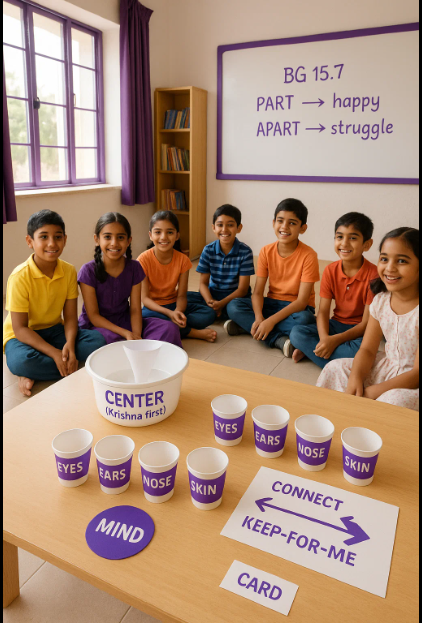
Core props
-
1 large CENTER bowl (mixing bowl works)
-
1 paper funnel (roll an A4 & tape) + 1 paper cap (to block funnel)
-
5 small cups labeled: Eyes, Ears, Nose, Tongue, Skin
-
Tape/Blu-tack for labels + a tray/table for the “Center Station”
Tokens (printables or substitutes)
-
FOOD tokens (×36) → print: tokens_food_v2.svg
(or 36 purple pom-poms/buttons) -
ENERGY tokens (×36) → print: tokens_energy_v2.svg
(or 36 darker chips/beans) -
HAVOC tokens (×24) labeled Angry, FOMO, Tummy, Tired, Distracted, Noise → print: tokens_havoc.svg
(or 24 red chips/Post-its) -
3 shallow bowls or zip-bags to sort FOOD / ENERGY / HAVOC
Cards (who decides what happens)
-
Distraction Cards (APART choices) (×8) →
(Snooze/Phone first, Snack first, Just one reel, Loud noise, Follow the smell, Too comfy to bow, Win only, Me-first plan) -
Connect-First Cards (PART choices) (×8) →
(Bow once, Hare Krishna 10s, Read 1 line from BG, Offer first, Thank you Krishna, Stop-Breathe-Connect, Kirtan 20s, Offer effort) -
Mind badge/sign (optional) and Sense badges (nice for clarity) → from earlier pack:
Nice-to-have classroom helpers
-
Painter’s tape to mark a single-file line to the funnel
-
Small timer/phone with a 60–90s kīrtan loop (start/stop cue)
-
1 clipboard for Scorekeeper
-
2 trays: one for Mind & Cards, one for Tokens
Quantities by class size
-
Up to 16 kids (Co-op mode): the counts above are enough.
-
16–30 kids (Team Relay): print double tokens (FOOD/ENERGY 60–72 each; HAVOC 36) so rounds don’t stall. Keep one Center/funnel for clarity.
Start. Pick your mode
Mode A — Co-op (whole class together) ← easiest (best for ≤16 kids)
-
Active roles at a time (7 kids): 1 Mind, 5 Senses (Eyes/Ears/Nose/Tongue/Skin), 1 Funnel Captain (optional).
-
Adults/Helpers: Token Master (you) and Scorekeeper (helper/older child).
-
Everyone else = Chant Crew; they rotate in next round.
Mode B — Team Relay (2 teams) ← fun for 16–30 kids
-
-
Split into Team Gokul and Team Govardhan.
-
Each team fields 1 Mind + 5 Senses (6 kids per team on the floor).
-
You still keep one CENTER and one funnel. Teams take turns per mini-round (keeps it calm/clear).
-
Roles (who does what)
- Make one child the Mind. Make five children senses - give each sense 6 Food Coupons. Teacher should keep Energy coupons. Make one child Funnel Master or Teacher can do it.
-
Mind (child): From the Card stack draws a Distraction or Connect-First card, speaks the line, and signals Cap ON/OFF to Funnel Master (Distraction=Cap on and Connect=Cap off).
Lines:
• APART: “Keep for me!” (shows Distraction card)
• PART: “Feed the CENTER first!” (shows Connect-First card) -
Senses (5 children): Hold their labeled cups.
• In APART, each Sense drops ONE FOOD token into their own cup.
• In PART, each Sense carries FOOD token to the funnel and pours it into the CENTER. -
Funnel Captain (optional child): Physically caps/uncaps the funnel on Mind’s cue.
-
Token Master (you):
• Hand out ENERGY tokens to all Senses whenever FOOD goes through the CENTER (rule below).
• Place/remove HAVOC tokens in a Sense’s red zone.
• Keep tokens tidy and pace the game. - Chant Crew: Call-and-response lines:
“APART → struggle!” / “PART → happy!” -
Quick rule (say it often)
“ENERGY = stand & shine. No energy = sit & droop.”
Start Activity
- Mind will sit on a chair with cards on the table. All senses should stand to begin with.
- Ask Mind to pick a card.
If Mind picks a Distraction (APART)
-
Cap ON.
-
Each Sense drops ONE FOOD token into their own cup (nothing reaches CENTER).
- No ENERGY is given. Meters do not move.
-
Class call: “APART → struggle!”
- Senses sit and droop!
If Mind picks a Connect Card (PART)
-
Cap OFF.
-
Senses carry FOOD to the funnel and pour into CENTER.
-
Token Master gives 1 ENERGY token to EACH Sense (yes, all five). If the senses are sitting then they will jump up and stand happily (since they got energy). If they are already standing they will jump up once and chant Hare Krishna.
- Class call: “PART → happy!”
Continue to play till time permits. You can give chance to another set of children for the mind and senses.
Wrap up
Ask:
-
Who am I? → Krishna’s tiny, forever PART.
-
What happens APART? → Struggle (karṣati).
-
How to be PART? → Connect first (chant/bow/learn).
Song - Bhaja Hu Re Mana
Chorus (call & response):
Bhaja hū re mana — “Hey mind, worship!”
Śrī-nanda-nandana — “Krishna, son of Nanda.”
Abhaya-caraṇāravinda re — “At His fear-free lotus feet.”
Kid-friendly meaning (say while they echo):
“Hey Mind, choose Krishna. At His lotus feet there is no fear.”
Tie to 15.7 (say before the last repeat):
“BG 15.7 says I’m Krishna’s tiny PART. When my mind connects here (points to feet), I’m happy.”
Practical Application in daily life for practice (Parents can help)
Real-life “Connect-First” suggestions:
-
Morning: bow once + “I’m Your tiny PART.”
-
Meals: offer first → eat prasādam.
-
Homework: read BG 15.7 once + 10-sec mantra, then start.
-
Screens: 60-sec chant before watching.
-
Fights: STOP → BREATHE → CONNECT (Hare Krishna ×3), then speak kindly.
-
Bedtime: 3 gratitudes + 10-sec mantra.
Chant one round
Damodar Lila
Shloka - Patram Pushpam Phalam Toyam
Materials needed - One small tulasi leaf, One fruit, One flower and One glass of water
IMPORTANT : Please request Parents one day ahead of time to send any one of these with their child. There will be a common Damodar lamp offering with elders at the end of the class. Whatever the children bring can be offered in front of the Lord then.
patraṁ puṣpaṁ phalaṁ toyaṁ
yo me bhaktyā prayacchati
tad ahaṁ bhakty-upahṛtam
aśnāmi prayatātmanaḥ
1️⃣ Warm-Up (1 min)
- Ask: “When you give something to your best friend, how do you give it—carelessly or with love?”
- Explain: “In this verse, Krishna tells us what He loves to receive from His friends.”
2️⃣ Listen & Repeat – Word by Word (3 min)
Use a call-and-response method. Teacher says → Children repeat (loud, clear, rhythmic):
Teacher says Children repeat
patraṁ patraṁ
puṣpaṁ puṣpaṁ
phalaṁ phalaṁ
toyaṁ toyaṁ
yo me bhaktyā prayacchati yo me bhaktyā prayacchati
tad ahaṁ bhakty-upahṛtam tad ahaṁ bhakty-upahṛtam
aśnāmi prayatātmanaḥ aśnāmi prayatātmanaḥ
Show with actions:
- patram (show tulasi leaf)
- puṣpam (show flower)
- phalam (show fruit)
- toyam (show glass of water)
3️⃣ Line-by-Line Recitation (2 min)
Now chant one full line, they repeat:
patraṁ puṣpaṁ phalaṁ toyaṁ
(Children repeat)
yo me bhaktyā prayacchati
(Children repeat)
…and so on.
Do this twice slowly. Meaning (2 min)
Tell the meaning in simple English:
“If someone offers Me a leaf, a flower, a fruit, or a little water with love, I accept it.”
Ask:
“What is most important—what we give or how we give?”
Children answer: “How we give—with love!”
The Rope of Love – The Dāmodara Story
Materials needed : One pot, one small stone, one small rope
Pre Preparation : You can tell this story and also enact it at the same time. Make one child Krishna. Teacher herself (if mataji) can become Yashoda or take one Assistant to do it.
🎬 Scene 1 – Mother Yaśodā’s Morning Love
Once upon a time in Gokula, Mother Yaśodā’s maid was busy,
so Yaśodā Mātā herself began to churn butter for her little boy Kṛṣṇa.
She tied her sari tightly, sat near the pot, and pulled the churning rope back and forth, back and forth — swish-swish, jhan-jhan! (gesture churning).
As she churned, she sang softly:
“Govinda Dāmodara Mādhaveti…” 🎶
Her bangles jingled, her earrings swung, drops of milk flowed from her heart full of love. Children can sway gently to the rhythm.
Just then, Kṛṣṇa toddled in — His eyes like blooming lotuses.
He felt hungry! He pulled His mother’s sari and looked up with baby hands saying,
“Mā … milk!” 🍼
She smiled, lifted Him, and lovingly fed Him.
The room glowed with sweetness.
🎬 Scene 2 – The Milk Boils Over
While Kṛṣṇa was drinking, the milk on the stove began to rise — ssshh … sputter … boil over!
Yaśodā cried, “Oh! The milk!” and gently put Kṛṣṇa down to save it.
But our naughty boy didn’t like being put aside! 😠
His eyes turned red, His lips quivered — “How could she leave Me?”
He picked up a little stone and crack! broke the butter pot!
Then, with fake tears, He sat in a corner eating butter and feeding the monkeys. 🐒
(Have one “Kṛṣṇa” and a couple of “monkeys” enact this while others giggle softly.)
🎬 Scene 3 – The Great Chase
When Yaśodā returned, she saw the broken pot and buttery footprints.
She smiled: “This must be Kṛṣṇa’s work! Where has He gone now?”
She looked around — and saw Him on top of an upside-down grinding mortar,
feeding butter to monkeys, looking left and right nervously. 👀
Very quietly she tip-toed forward (teacher and children mime tip-toeing).
Kṛṣṇa saw the stick in her hand and ran!
Round and round the courtyard — tiny feet ringing with ankle bells —
the Supreme Lord whom great yogīs cannot catch was running away from His mother!
Yaśodā Mātā ran too, her hair loosening, her flowers falling.
Finally, panting, she caught Him!
Kṛṣṇa rubbed His eyes, ready to cry. 😢
🎬 Scene 4 – The Rope That Was Too Short
Mother Yaśodā threw away the stick.
“Don’t cry, my naughty one,” she said.
“But you must be punished a little — I’ll tie you so you don’t make more mischief.”
She brought a rope — but when she tried to tie His belly,
it was two fingers short!
She got another rope — still short!
All the ropes in the house joined together — still two fingers short!
Children chant softly, clapping:
“Two fingers short! Two fingers short!”
Yaśodā laughed but kept trying, perspiring, her garland slipping down.
Finally, seeing her exhaustion and love, Kṛṣṇa smiled and let Himself be tied.
(Using the rope, “Yaśodā” gently ties “Kṛṣṇa.”)
Teacher explains softly:
The two fingers mean our effort and Kṛṣṇa’s mercy. When both meet, Kṛṣṇa stays tied in our heart.
🎬 Scene 5 – The Miracle of the Arjuna Trees
Now Kṛṣṇa sat tied to the wooden mortar, still thinking,
“Mother left Me without feeding, tied Me up — hmm, let Me do something more fun!” 😏
He crawled, pulling the heavy mortar between two tall arjuna trees that stood side by side.
The mortar got stuck — He pulled harder — crash! 🌳🌳
Both trees fell with a thunderous sound!
From the trunks came two shining beings — Nalakuvara and Maṇigrīva, sons of Kuvera.
They folded their hands and said:
“O Lord, we were cursed to stand as trees,
but by Your mercy and Mother Yaśodā’s love we are now free!”
They offered prayers and disappeared.
Kṛṣṇa just smiled innocently — as if nothing had happened.
🪔 Closing Reflection
Teacher speaks softly:
“See, children, the Supreme Lord whom even great yogīs cannot catch
was caught by His mother’s love.
This is why He is called Dāmodara — ‘the Lord bound by the belly.’”
Whenever we offer a small leaf, a flower, a fruit, or water with love — or a simple lamp in Kartika month — Kṛṣṇa accepts it, just as He accepted Yaśodā Mātā’s love.
Activity - My Offering Plate for Krishna
“I may not have much, but I can offer something with love.”
🪔 Materials Needed
-
One paper plate per child
-
Colored paper (green for leaf 🍃, pink for flower 🌸, orange/red for fruit 🍎, blue for water 💧)
-
Scissors ✂️, glue stick
-
Crayons or sketch pens
-
One small printed/pasted image of Dāmodara in the center
🪷 Steps
-
Paste Damodara's picture in the center of the plate.
-
Around it, glue four diya cut-outs (teacher can cut in the shape of diya):
-
A leaf (patram)
-
A flower (puṣpam)
-
A fruit (phalam)
-
A drop or cup of water (toyam)
-
-
Below, let the child write:
This Kartika I will offer ___________ to Damodara daily (children can choose to write tulasi leaf, a flower, a fruit, some water (any one or two or three - tell them to choose something that they think they CAN do)
- Emphasize that they are taking a vow and should try to follow it with discipline.
-
Optional: Decorate plate rim with lace, glitter, or stickers labelled “With Love” and “Bhakti Plate”.
💖 Message to Reinforce
“Kṛṣṇa doesn’t count what we give — He feels the love we give it with.”