Stillness in the Hustle
25 Life Lessons from the Bhagavad-gita for a World That Won’t Slow Down
#1 Where do we Start?
Sometimes, the most difficult questions come from the simplest mouths.

On 12 June 2025, Air India Flight 171, a Boeing 787-8 Dreamliner, departed from Ahmedabad’s Sardar Vallabhbhai Patel International Airport en route to London Gatwick. It stalled at around 625 ft shortly after takeoff and crashed into a building on the campus of B.J. Medical College in Ahmedabad. The plane carried 242 people (230 passengers, 12 crew); 241 aboard and at least 29 on the ground were killed, making it one of India’s worst air disasters in decades.
My maid asked me, Saab, ye aisa kyun hua - Bhagvan ne kiya kya?
(Sir, why did this happen—did God do it?).
I had no answer in the moment. But later that night, I opened the Bhagavad-gita and found a framework that made sense—not just for this tragedy, but for life itself.
Everything is contained in five factors
Krishna explains that everything in creation—every joy, every tragedy, every moment—is shaped by the interplay of five fundamental factors:
- The human being
- God
- The world in which the human lives
- The actions that humans do
- Time
If we observe the world around us carefully, everything can be understood through these five lenses.
Let us look at a few examples:
- Air India Crash
- Human beings: Pilots, passengers, engineers.
- God: The ultimate sanctioning authority.
- World: The aviation system, airport infrastructure, weather conditions.
- Actions: Maintenance checks, pilot responses, human errors.
- Time: The specific moment—12 June 2025—when all factors converged.
- A Student Passing an Exam
- Human being: The student.
- God: Sanctions the result.
- World: School, exam system, access to resources.
- Actions: Studying, discipline, preparation.
- Time: The examination date, deadlines, result declaration.
- A Couple Getting Married
- Human beings: The bride, groom, families.
- God: Brings the souls together.
- World: Society, culture, location.
- Actions: Mutual choice, planning, rituals.
- Time: The destined moment of union.
- A Man Missing His Train
- Human being: The commuter.
- God: Permits the outcome.
- World: Train schedule, traffic conditions.
- Actions: Leaving late, distractions.
- Time: The departure minute, missed by seconds.
If we understand these five elements clearly, we can find our place and purpose in this world. At the same time, we can scientifically understand how the whole thing works and, in the process, get answers to our questions—from the simple to the most complex.
Gita is addressing three questions
The Bhagavad-gita essentially talks about these five elements. But we can make it even simpler by translating them into three key questions:
- Who am I?
- Whose am I?
- Where am I?
These are the three questions that the Gita is addressing—simple.
In a nutshell
- Who am I? I am a spirit soul.
- Whose am I? I am Krishna's.
- Where am I? I am in a temporary body in a temporary material world doing actions over a period of time.
To summarize
We are eternal souls, and we are Krishna's children. We belong to the spiritual world (Vaikuntha). We chose to rebel against Krishna and entered this temporary material world. The supreme goal of life, then, is to reconnect with Krishna through yoga and return home—back to where we belong.
This is the sum and substance of all Vedic literature. This is the BIG picture. Everything else is a detail.
In the rest of the book, we will go deep into these three questions.
“The living entities in this conditioned world are My eternal fragmental parts. Due to conditioned life, they are struggling very hard with the six senses, which include the mind.”
— Bhagavad-gita 15.7
#2 Where did Mahatma Gandhi, Lord Brahma and iPhone come from?

The Bhagavad-gītā does not debate the existence of God. It assumes that rational human beings can arrive at that understanding through observation, reflection, and intuition. Rather than asking, “Does God exist?”, it encourages us to examine the world deeply and honestly—to infer divinity from the very structure of existence itself.
Science vs. Spirituality — A False Divide
A common misconception today is that science and spirituality cannot go together. People assume that believing in God is “unscientific.” But in truth, some of the greatest scientists in history—those who shaped the very foundations of modern science—were firm believers in a higher intelligence.
Great Scientists Who Believed in God:
• Isaac Newton: “Gravity explains the motions of the planets, but it cannot explain who sets the planets in motion.”
• Albert Einstein: “I want to know God’s thoughts; the rest are details.”
• Max Planck: “Mind is the matrix of all matter.”
• Louis Pasteur: “The more I study nature, the more I stand amazed at the work of the Creator.”
• Johannes Kepler: “I was merely thinking God’s thoughts after Him.”
Inferring God Through Reason
Let us follow the evidence where it leads.
In everyday life, we instinctively infer a cause from an effect. When we see a painting, we assume there’s a painter. When we find a complex machine, we assume it was built by an engineer. This principle of causality is embedded in human reasoning.
Now apply the same logic to the universe.
Creation Implies a Creator
 World's most complex watch.
The Vacheron Constantin Les Cabinotiers Solaria Ultra Grand Complication is widely considered the most complicated mechanical wristwatch ever made. It boasts 41 complications and 1,521 components.
Could this watch have come "by chance"? You think. It took eight years to make the Watch.
In essence Creation automatically implies there is a Creator. One can look at the watch and be sure there must have been a person behind it. Similarly then we live in this world - shouldn't it have a Creator behind it?
Some say that this Universe came out of nothing. When was the last time you saw something come out of nothing?
What about the Big Bang bro?
We marvel at galaxies, black holes, and the birth of the cosmos. But even more wondrous is that it all began with the Big Bang. Can an explosion on its own create such precision and order?
Imagine a bomb going off in a printing press and producing an encyclopedia. That’s absurd. So why believe that a chaotic blast created a finely tuned, law-governed universe?
Design Implies a Designer
 Michelle Obama Lands in Indian Designer's Clothes
During Jan-2015 Michelle Obama visited India with her husband US President Barack Obama. She had India Buzzing About Her Outfit.The first lady emerged from Air Force One wearing Bibhu Mohapatra. Many asked her "Who is the Designer".
Very simply whenever we see design in this world we automatically assume there is a Designer. Similarly in this world we are surrounded by Design in nature - from the Rose to the Human body. God is the Designer who designed his World in very specific ways.
Take the human eye. Its iris contracts with light, the lens adjusts focus, and millions of nerves transmit signals to the brain. Biologists agree the eye is “irreducibly complex.”
Now consider DNA: a digital code inside every cell, three billion letters long, precisely sequenced. Who wrote that code? Codes don’t write themselves.
Laws Imply a Lawmaker
From gravity to thermodynamics, the universe operates on consistent, intelligible laws. But laws presuppose a lawgiver. Why does nature obey mathematics? Why do electrons always repel, or apples always fall?
Such elegant predictability doesn’t emerge from chaos. It suggests intelligence—an architect behind the curtain.
Just as architecture proves the presence of an architect, the structured cosmos points to an Intelligent Designer—what many call God.
Inferring God Through Science
During the COVID-19 crisis, “oxygen cylinder” became one of the most searched terms on Google. Hospitals were charging thousands for a single cylinder.
Yet the same oxygen that cost a fortune in ICUs surrounds us freely—on land, in the oceans, in caves, even at high altitudes.
Pause and consider: oxygen is everywhere, because life needs it everywhere. This is not coincidence—it is provision.
Take water as contrast. If I am thirsty, I must walk into the kitchen and pour a glass. Water isn’t available in mines or deserts unless brought there. But oxygen? It’s always present. This is divine logistics at work.
Now extend that to other finely tuned arrangements:
- The Earth’s distance from the Sun is exactly right for liquid water.
- The atmospheric pressure allows lungs to function perfectly.
- The force of gravity is neither too strong nor too weak.
- The electromagnetic force enables atoms to form molecules.
This level of precision is not random—it cries out for a benevolent intelligence behind the scenes.
Inferring God Through Scripture
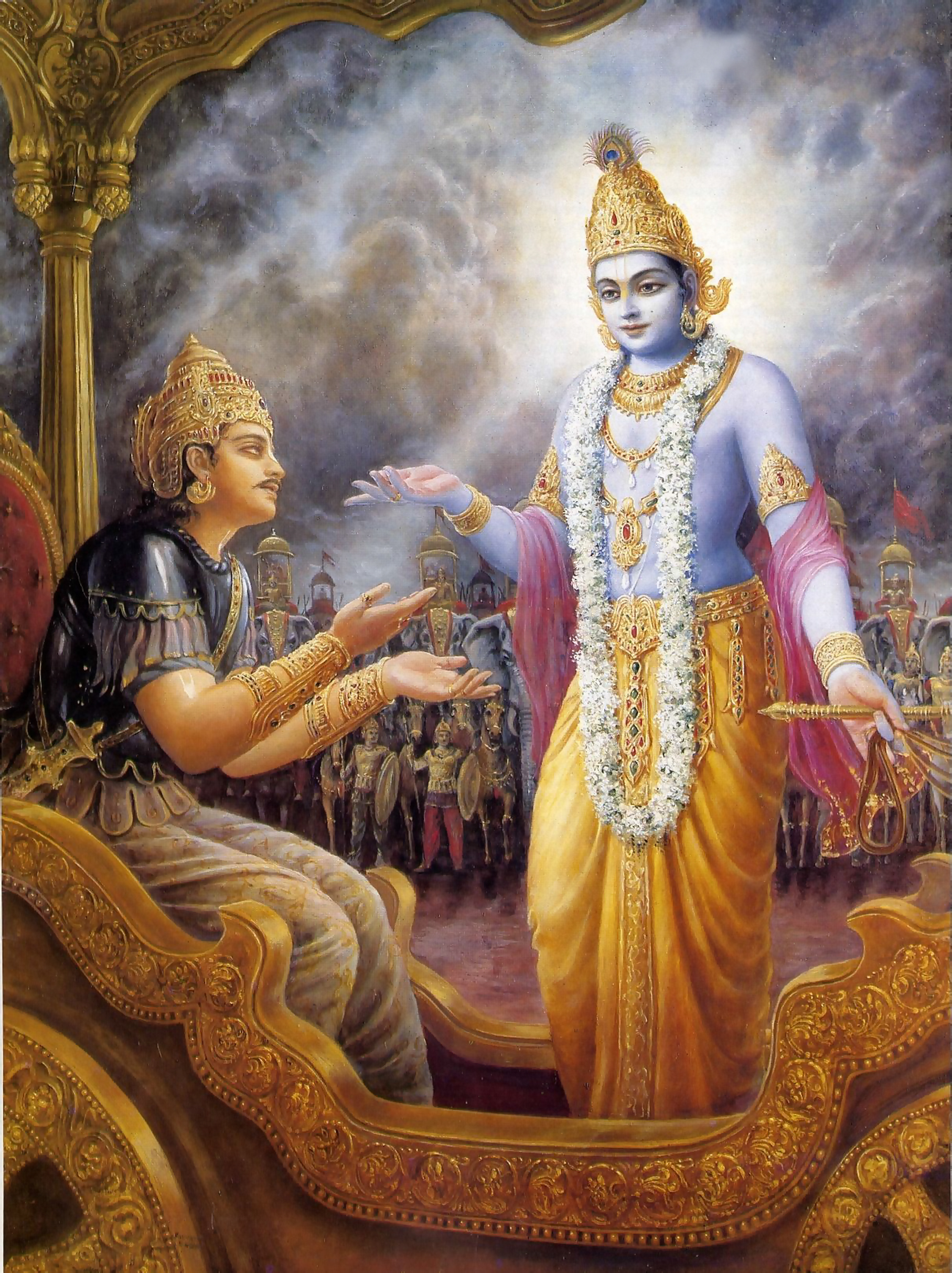
The Bhagavad-gītā makes it simple. Krishna declares:
“I am the source of all spiritual and material worlds. Everything emanates from Me. The wise who perfectly know this engage in My devotional service and worship Me with all their hearts.”
— Bhagavad-gītā 10.8
“Everything rests upon Me, as pearls are strung on a thread.”
— Bhagavad-gītā 7.7
In Vedic thought, God is not just the creator, but the sustainer and the regulator of all existence. He is described as the “Cause of all Causes” (sarva-kāraṇa-kāraṇam).
This is not a sectarian concept—it is a definition of divinity accepted across most religious traditions.