
Bal Gopal - Lesson #6
Syllabus
- BG 15.7 - Mamai vamsho
- Story - Govardhan
- Vaishnav Song - Bhaja hu re mana
Recap of last week
Last week was Bal Gopal #5 (Cheto Darpana Marjanam)
- "Children - let us recap what we discussed in the last class - please tell what points you remember".
- Appreciate responses.
- Teacher - "Children what are the SIX dirty things in our heart?"
- We cannot be happy inside a room that is full of dirt. Similarly Krishna is also not happy inside our dirty heart. When we chant Hare Krishna, our becomes clean and beautiful, and Krishna is happy to live in our heart.
- Teacher - "Children are any of you chanting daily?". Give a Sticker to those who are and encourage other children while emphasizing that we cannot be happy with a dirty heart.
Shloka BG 15.7
ममैवांशो जीवलोके जीवभूत: सनातन: ।
मन:षष्ठानीन्द्रियाणि प्रकृतिस्थानि कर्षति ॥ ७ ॥
The living entities in this conditioned world are My eternal fragmental parts. Due to conditioned life, they are struggling very hard with the six senses, which include the mind.
Call & response (with actions):
-
mamaivāṁśo jīva-loke (point to heart)
-
jīva-bhūtaḥ sanātanaḥ (spread arms “forever”)
-
manaḥ-ṣaṣṭhānīndriyāṇi (tap head + show 5 fingers)
-
prakṛti-sthāni karṣati (mime tug/pull)
Kid meaning: “I’m Krishna’s tiny, forever PART. When my mind + five senses pull me APART, I struggle.”
Story - Udarendriyāṇām
[[Teacher should adapt and tell with enthusiasm, body motion and facial expressions - It is a very powerful story that communicates a key principle of this Universe - so do it nicely]
[This story is told by Srila Prabhupada]
There is a story in the Hitopadeśa: Udarendriyāṇām. Udara. Udara means this belly, abdomen, and indriya means senses. Udarendriyāṇām. What is that? All the different parts of the body, hands, legs, fingers and everyone, they held a meeting, that "We are working day and night, and this rascal abdomen is sitting down and eating only. (laughter) He is doing nothing. We are collecting everything, and putting into the stomach, and he is eating, very..., sitting nice. So strike: 'We shall not work.' So strike." Udara... Udara said, "All right, you strike. What can I do? I cannot work. You can strike." So they did not work. Did not work means there was no food, no food given to the stomach. They..., gradually they became weak. The indriyas, the different parts of the body, they became weak, because if there is..., if you cannot eat, naturally you shall be... Then again, next meeting they held that "What is this? Why we are becoming weak?" Then they decided that "The stomach must be given, sir. We have to work."
This is our position. Kṛṣṇa is bhoktā, and we are parts and parcel of Kṛṣṇa. That means we have to work for Kṛṣṇa. This is a fact. If you don't work for Kṛṣṇa, then you'll starve. That is the position. But these rascals, they do not know. Na te viduḥ svārtha-gatiṁ hi viṣṇum [SB 7.5.31]. Exactly in the same way as these rascals, different parts of the body, limbs, they did not know that "Without satisfying the stomach, we shall die," similarly these rascals, these karmīs, these, those who have come to this material world, they do not know that without conscious, Kṛṣṇa consciousness, without satisfying Kṛṣṇa, they'll simply starve. Struggle for existence. Kliśyanti. Simply their labor will be frustrated. That is the philosophy.
Story telling
1. Introducing the Body Parts
-
Hands: Hold up your hands and show them working (as if collecting fruits or sweeping).
-
Legs: March a little in place to show legs are always moving and carrying the body.
-
Eyes: Point to your eyes and make big wide-open expressions (“We are working hard, watching everything!”).
-
Mouth: Move lips or pretend chewing, but then shake head to show “not eating, only working.”
2. Complaint Against the Belly
-
Point to your stomach with a slightly annoyed expression and say in a funny, dramatic tone:
“This belly is just sitting there… not working, only eating!”
Cup your hands around your mouth like whispering to the children:
“Let’s go on strike!”
Gesture: Cross your arms and make an angry “No!” gesture (hands waving side to side).
3. The Strike
-
Show the hands becoming lazy: drop them down loosely.
-
Show the legs giving up: sit down or pretend to stumble.
-
Even make the eyes look droopy (half-closed, tired).
-
Tell children to copy you – it will make them laugh and join in.
4. Weakness Appears
-
Act out getting weaker: bend your knees, droop shoulders, speak in a faint voice:
“Oh… we have no energy now…”
Gesture: Hold your belly and show it shrinking or rubbing it like “hungry.”
5. Realization
-
Suddenly clap your hands and say:
“Wait! We must feed the stomach, otherwise we all suffer!”
-
Show putting food into the stomach (mime eating with hands, rubbing belly happily).
-
Then show the hands regaining strength (make fists and flex muscles), legs jumping again, eyes bright and wide.
6. Moral
-
Gesture: Put your hand on your heart and then lift both hands up to the sky.
“If we keep Krishna (like the stomach) in the center, everyone becomes strong and happy!”
Extra Tip:
You can involve children by assigning them roles:
-
One child is the belly (sits peacefully).
-
Others are hands, legs, eyes, mouth (act busy, then strike, then become weak, then realize).
This way it becomes a mini-drama they will never forget.
Conclude - We are part of Krishna - by serving him we are automatically happy and nourished - just like the hand is happy and nourished by giving the laddu to the Stomach.
Story - Govardhan Pūjā — "Serve Krishna, the Center - then every part of life if happy"
Once, in the sweet village of Vṛndāvan, the harvest was finished. The air smelled of grass and rain, and the cows’ bells chimed like tiny temple bells. Everyone bustled about, polishing pots, piling sweets, arranging garlands. Why? Because it was the day they usually offered a big worship to Indra, the lord of rain.
Little Kṛṣṇa watched all this with bright, curious eyes. He tugged gently at Nanda Bābā’s cloth.
“Bābā,” He asked, “whom are we worshiping today?” (tilt head, curious smile)
“To Lord Indra, my son,” Nanda replied. “He sends the rains for our fields and pasture. Without rain, how will our cows eat? How will we live?”
Kṛṣṇa looked up at the blue autumn sky, then across the green of Vṛndāvan to the great brown-green back of Govardhan Hill rising like a quiet protector.
“Bābā,” He said softly, “tell me—who is the Center of our lives?” (hand to heart)
Nanda thought. “We are cowherds; our lives depend on cows, pasture, the hill, the streams.”
Kṛṣṇa’s smile grew. “Then let us serve the Center—the one who feeds and shelters us every day. Govardhan gives grass to our cows, stones for our paths, caves for our storms, streams for our thirst. He is My own. If we feed the Center, every part will be satisfied.” (gesture a circle with one finger, then a single point in the center)
The elders murmured. The gopīs paused, ladles in the air. The boys set down baskets of sweets. It felt new—and true. Nanda nodded slowly. “So be it. Today, we will make Annakūṭa—a mountain of food—for Govardhan, and offer with love to You, Kṛṣṇa.”
And so they did. Pots bubbled. Ghee shone like liquid gold. Mountains of rice were crowned with jewels of vegetables. Laddus rolled like little moons. The village became a festival of color and fragrance. Before the hill they arranged everything—leaf, flower, fruit, water—simple gifts, and also rich ones, all with the same heart.
Kṛṣṇa stood before Govardhan, palms joined. “O Govardhan, O dear friend, O Center of Vraja’s life—please accept.” (bow gently) The people bowed. The cows lowed softly. A sweetness settled over the hill, as if the earth itself sighed with joy.
But far away, Indra heard that Vṛndāvan had not held his usual worship. Pride rose in his heart like a dark cloud. “They neglect me?” he thundered. “I will show them who brings the rain!” He summoned the cruel Sāmvartaka clouds. The sky blackened. Winds clawed the trees. Lightning tore the day. Rains crashed down like rivers dropped from the sky.
In moments, Vṛndāvan was a whirl of shouting and running and frightened animals. Mothers held children close. Calves cried for the shelter of their mothers’ sides. The Yamunā swelled and moaned.
Kṛṣṇa’s face did not change. (calm, kind gaze) “Do not fear,” He said. “When we feed the Center, the Center feeds and protects us.” He walked to Govardhan Hill, and with His little left finger, He slipped it beneath the great rock and lifted. (hand lifts lightly, palm up) The hill rose like a vast emerald umbrella. “Come,” He called, “bring the cows, the carts, the children, the grandparents—everyone.”
Under the shelter of Govardhan, it was dry and warm and bright with oil lamps. The seven-colored ribbons of rain hissed beyond the edges, but inside there was only the jingling of bells, the soft beat of hearts, the murmur of kīrtan. Kṛṣṇa stood there, the hill resting effortlessly upon His finger, as easily as a boy holds a peacock feather. (soft smile)
Seven days and seven nights the storm raged. Seven days and seven nights Kṛṣṇa stood, His eyes kind, His arm steady, the people of Vṛndāvan gathered close like beads on a single thread. When a child grew sleepy, He smiled at the mother. When a calf trembled, He nodded to the cowherd to bring it nearer. When thunder cracked, He glanced once at the clouds, and even thunder seemed to remember its manners. (gentle nod)
At last Indra’s pride melted, washed away by his own storm. The clouds thinned, the sun peeked, and the raindrops on the hilltop looked like a crown of diamonds. Indra descended, ashamed, setting aside his thunder. He bowed to Kṛṣṇa. “O Lord,” he said, voice small in the bright air, “I was proud. I forgot I am only a part. You are the Center I should have served.” (lower voice, humble)
Kṛṣṇa’s gaze was cool and compassionate, like shade on a noon path. “Indra,” He answered, “rain has its place; you do your service. But never forget the Center. When the mind rushes to praise the parts first, havoc comes—like your storm. When we serve the Center, every part is nourished—like Vṛndāvan under this hill.” (point gently upward, then open palm to the people)
Indra bowed again and returned to his post, humbler, wiser. Kṛṣṇa lowered Govardhan, as tenderly as a mother lays a child to sleep. The hill settled back into the earth with a contented hush.
The village spilled into sunlight—laughing, crying, patting the glossy backs of the cows, touching Kṛṣṇa’s feet with tears bright as the morning. Nanda Bābā embraced Him. Yaśodā Mātā kissed His hair. The gopas danced; the gopīs sang; the grandparents blessed Him with trembling hands. Vṛndāvan was once more the soft green world that knew His footsteps.
That evening, as lamps winked on in the doorways and the Yamunā sang her silver song, Kṛṣṇa sat with His friends on the grass. One boy asked, “Kanhaiyā, will there be storms again?” Kṛṣṇa looked at them, then at the hill, then back to their open, waiting faces.
“Storms come,” He said. “Sometimes they come outside—wind and rain. Sometimes they come inside—when mind and senses pull us to feed the little parts first: ‘my wants, my pride, my plan.’ (small tugging motion) But remember: Feed the Center first. Offer what you have with love—to Govardhan, to Me—and strength will flow to every part. Then even when clouds gather, your hearts will stay bright.” (hand to heart, lift palm upward)
The boys nodded. One by one they whispered, “Center first,” as if it were a secret that made their pockets warm. The cows grazed. Fireflies stitched golden threads in the dusk. Govardhan stood watch, great and quiet and kind.
And in Vṛndāvan, whenever the sky grew dark or a worry tried to blow through, people remembered that day. They remembered Kṛṣṇa’s little finger, the sheltering hill, the way fear turned into singing. They remembered: “Serve Kṛṣṇa, the Center—then every part of life is happy.” (smile; soft pause)
One-line takeaway for kids
“Serve Krishna, the Center—then every part of life is happy.”
Activity
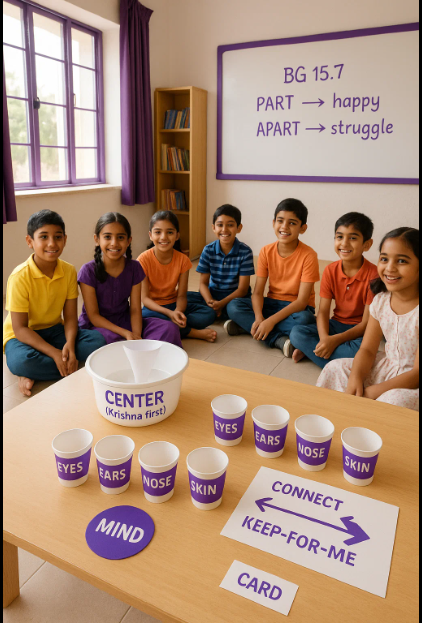
Core props
-
1 large CENTER bowl (mixing bowl works)
-
1 paper funnel (roll an A4 & tape) + 1 paper cap (to block funnel)
-
5 small cups labeled: Eyes, Ears, Nose, Tongue, Skin
-
Tape/Blu-tack for labels + a tray/table for the “Center Station”
Tokens (printables or substitutes)
-
FOOD tokens (×36) → print: tokens_food_v2.svg
(or 36 purple pom-poms/buttons) -
ENERGY tokens (×36) → print: tokens_energy_v2.svg
(or 36 darker chips/beans) -
HAVOC tokens (×24) labeled Angry, FOMO, Tummy, Tired, Distracted, Noise → print: tokens_havoc.svg
(or 24 red chips/Post-its) -
3 shallow bowls or zip-bags to sort FOOD / ENERGY / HAVOC
Cards (who decides what happens)
-
Distraction Cards (APART choices) (×8) →
(Snooze/Phone first, Snack first, Just one reel, Loud noise, Follow the smell, Too comfy to bow, Win only, Me-first plan) -
Connect-First Cards (PART choices) (×8) →
(Bow once, Hare Krishna 10s, Read 1 line from BG, Offer first, Thank you Krishna, Stop-Breathe-Connect, Kirtan 20s, Offer effort) -
Mind badge/sign (optional) and Sense badges (nice for clarity) → from earlier pack:
Nice-to-have classroom helpers
-
Painter’s tape to mark a single-file line to the funnel
-
Small timer/phone with a 60–90s kīrtan loop (start/stop cue)
-
1 clipboard for Scorekeeper
-
2 trays: one for Mind & Cards, one for Tokens
Quantities by class size
-
Up to 16 kids (Co-op mode): the counts above are enough.
-
16–30 kids (Team Relay): print double tokens (FOOD/ENERGY 60–72 each; HAVOC 36) so rounds don’t stall. Keep one Center/funnel for clarity.
Start. Pick your mode
Mode A — Co-op (whole class together) ← easiest (best for ≤16 kids)
-
Active roles at a time (7 kids): 1 Mind, 5 Senses (Eyes/Ears/Nose/Tongue/Skin), 1 Funnel Captain (optional).
-
Adults/Helpers: Token Master (you) and Scorekeeper (helper/older child).
-
Everyone else = Chant Crew; they rotate in next round.
Mode B — Team Relay (2 teams) ← fun for 16–30 kids
-
-
Split into Team Gokul and Team Govardhan.
-
Each team fields 1 Mind + 5 Senses (6 kids per team on the floor).
-
You still keep one CENTER and one funnel. Teams take turns per mini-round (keeps it calm/clear).
-
Roles (who does what)
- Make one child the Mind. Make five children senses - give each sense 6 Food Coupons. Teacher should keep Energy coupons. Make one child Funnel Master or Teacher can do it.
-
Mind (child): From the Card stack draws a Distraction or Connect-First card, speaks the line, and signals Cap ON/OFF to Funnel Master (Distraction=Cap on and Connect=Cap off).
Lines:
• APART: “Keep for me!” (shows Distraction card)
• PART: “Feed the CENTER first!” (shows Connect-First card) -
Senses (5 children): Hold their labeled cups.
• In APART, each Sense drops ONE FOOD token into their own cup.
• In PART, each Sense carries FOOD token to the funnel and pours it into the CENTER. -
Funnel Captain (optional child): Physically caps/uncaps the funnel on Mind’s cue.
-
Token Master (you):
• Hand out ENERGY tokens to all Senses whenever FOOD goes through the CENTER (rule below).
• Place/remove HAVOC tokens in a Sense’s red zone.
• Keep tokens tidy and pace the game. - Chant Crew: Call-and-response lines:
“APART → struggle!” / “PART → happy!” -
Quick rule (say it often)
“ENERGY = stand & shine. No energy = sit & droop.”
Start Activity
- Mind will sit on a chair with cards on the table. All senses should stand to begin with.
- Ask Mind to pick a card.
If Mind picks a Distraction (APART)
-
Cap ON.
-
Each Sense drops ONE FOOD token into their own cup (nothing reaches CENTER).
- No ENERGY is given. Meters do not move.
-
Class call: “APART → struggle!”
- Senses sit and droop!
If Mind picks a Connect Card (PART)
-
Cap OFF.
-
Senses carry FOOD to the funnel and pour into CENTER.
-
Token Master gives 1 ENERGY token to EACH Sense (yes, all five). If the senses are sitting then they will jump up and stand happily (since they got energy). If they are already standing they will jump up once and chant Hare Krishna.
- Class call: “PART → happy!”
Continue to play till time permits. You can give chance to another set of children for the mind and senses.
Wrap up
Ask:
-
Who am I? → Krishna’s tiny, forever PART.
-
What happens APART? → Struggle (karṣati).
-
How to be PART? → Connect first (chant/bow/learn).
Song - Bhaja Hu Re Mana
Chorus (call & response):
Bhaja hū re mana — “Hey mind, worship!”
Śrī-nanda-nandana — “Krishna, son of Nanda.”
Abhaya-caraṇāravinda re — “At His fear-free lotus feet.”
Kid-friendly meaning (say while they echo):
“Hey Mind, choose Krishna. At His lotus feet there is no fear.”
Tie to 15.7 (say before the last repeat):
“BG 15.7 says I’m Krishna’s tiny PART. When my mind connects here (points to feet), I’m happy.”
Practical Application in daily life for practice (Parents can help)
Real-life “Connect-First” suggestions:
-
Morning: bow once + “I’m Your tiny PART.”
-
Meals: offer first → eat prasādam.
-
Homework: read BG 15.7 once + 10-sec mantra, then start.
-
Screens: 60-sec chant before watching.
-
Fights: STOP → BREATHE → CONNECT (Hare Krishna ×3), then speak kindly.
-
Bedtime: 3 gratitudes + 10-sec mantra.
Chant one round
1 Comment
Exactly who touches what (quick cheat sheet)
Mind: Holds and reads the card; does not touch tokens.
Each Sense:
• APART → drops FOOD into own cup.
• PART → pours FOOD into funnel (CENTER).
Funnel Captain: Only caps/uncaps.
Token Master (you): Hands out ENERGY to all; places/removes HAVOC; keeps pace.
Class management tips (make it smooth)
Single line in front of the funnel; no running.
Use biggish tokens (avoid scattering).
Keep rounds short; chant cue = go/stop.
If time is tight: one APART and one PART round is enough—the cause/effect is crystal.